Hyperconverged infrastructure gives you the benefits of a public cloud with the control and privacy of traditional infrastructure.
Incorporating next-generation technologies such as the Internet of Things (IoT), artificial intelligence (AI), machine learning (ML), and big data to grow your business requires scalability and flexibility.
However, limited virtual computing options, including expensive private clouds and risky public clouds, make them unreliable for accelerating innovation and growth.
While your competitors may bring products to market or start introducing services before you, you need help configuring your servers, network, and storage to sync with virtual computing.
Hyperconverged infrastructure is emerging for digital businesses that need to host business applications on the cloud without managing minimal IT infrastructure such as separate servers, storage, and networks.
Difficulties in promoting innovation in digital business
Organizations that rely on information technology must focus on revenue generation, including sales, marketing, product innovation, and being a first mover. However, traditional IT infrastructure has many moving parts.
Before starting a new product development or innovation project, you need to configure software, development platforms, servers, storage, virtual machines, and countless other things.
Traditionally, physical servers and storage had a one-to-one relationship. This scenario increases the investment of effort and money into IT projects.
You might say that virtualization alleviates some of the drawbacks of traditional server and node systems. However, virtualization also has its drawbacks. The main problem is the increasing demand for storage capacity in virtual computing.
Businesses generate terabytes of redundant data, requiring continued investment in storage devices for business data centers. This approach wastes IT resources.
Therefore, wasted effort, money, working hours, and time are some of the main barriers to digital business innovation and growth.
What is HCI?
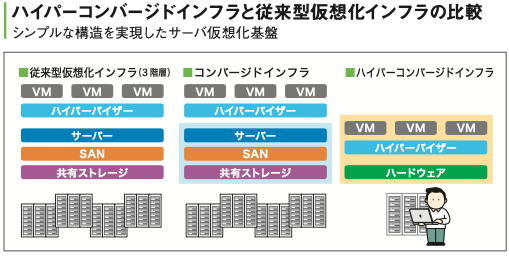
Hyperconverged infrastructure (HCI) is a futuristic architecture for data center design. This concept accommodates both small and large data centers. Traditional server-based systems have different sections: networking, computing, and storage.
Hyperconverged infrastructure (HCI) combines compute, virtualization, storage, and networking into a single cluster. A single vendor typically provides the entire package. At their core, computing, networking, and storage are hardware-controlled entities. Therefore, virtualization is either costly or not so easy for small and medium-sized businesses.
With HCI, software controls IT resources. IT resources such as compute, networking, and storage sit on top of the hypervisor.
You can simply modify the software from time to time to suit your project requirements. This saves your business on overhead costs for IT hardware and services.
A software-based data center control approach has created a new data center concept. You can deploy HCI systems on any hardware or hypervisor using:
- Application Programming Interface (API)
- virtual machine translation
HCI allows you to deploy converged infrastructure under software to control storage and compute resources. Different locations or departments of your business may need to use different hypervisors.
There is no need to purchase additional compute or storage resources for that hypervisor. HCI systems can convert virtual machines between hypervisors, allowing different departments to use shared resources without bandwidth contention.
Don’t stop here! HCI provides APIs that allow you to:
- Integrate your private cloud with public cloud platforms to meet your needs
- Bring your business data to the center beyond your private cloud architecture
- Integration and collaboration with external and internal hypervisors
- Use automation for business apps and tools
How HCI helps make IT more efficient
A business’s IT efficiency is determined by cost, complexity, and hybrid cloud access. HCI addresses all these requirements. More details below.
minimize complexity
HCI solutions are vendor-neutral. No need to chase multiple vendors for hardware and software compatibility support. You can control all IT resources in your data center using central software. By making changes within the app, you can configure your data center for different IT projects without interfering with hardware setup.
curtailment cost

IT resources can be transferred from one workstation to another and from one department to another. There is no need to have separate servers or storage farms for different departments within the same organization.
HCI also uses existing computing and networking protocols such as x86 servers and Ethernet ports. Therefore, there is no need to invest in expensive futuristic IT infrastructure.
Scaling up HCI involves automation. When your business or customer-facing apps suddenly experience traffic, HCI solutions automatically scale up on the backend. There’s no need to manually increase or decrease compute, storage, or network quotas.
Make way for hybrid cloud
HCI allows you to connect sandbox or private cloud computing to public cloud interfaces using advanced APIs. Everything goes through strict encryption and other security checks, so you don’t have to worry about the security of your business data.
How HCI works
HCI systems connect multiple data center server hardware to local storage and often include a software layer. The software distributes server capacity according to the workstation system load.
Virtualization also allows you to connect servers in different departments or office locations to create a comprehensive pool of computing, network, and storage resources.
Standard HCI includes the following components:
- One or more hardware chassis. These are primarily server resources. For high availability (HA) cluster appliances, you need to connect multiple HCI nodes.
- Storage area network (SAN) controllers are also displayed.
- Hypervisors for virtualization such as Hyper-V, VMware, and Citrix.
Advantages of HCI
- One vendor provides all software and hardware solutions, so you need to deal with a minimum number of vendors and their representatives.
- HCI hosts your storage, compute, and network devices in one place, reducing the time and money you spend managing your IT infrastructure.
- HCI resides near the business workstations where users use resources. Therefore, you can experience higher performance.
- HCI solutions come in simple packages, allowing businesses of all types to purchase HCI according to their workloads.
- HCI follows a building block strategy, so you can scale up or down by adding or removing HCI nodes.
Disadvantages of HCI
- HCI is still growing and may face vendor lock-in due to lack of standardization.
- There is a lack of open standards for logical or physical interoperability between nodes of different HCI vendors or systems.
- Initially, you may need to purchase storage, networking, and compute as a whole bundle, but you don’t need all three to scale up.
- HCI installations can require significant amounts of power to cool data center farms located in close proximity to each other.
- At least two HCI nodes are required to provide redundancy to each other and to be able to handle large workloads when traffic increases. Therefore, the cost of ownership may increase.
Converged vs. HCI: Differences
| Features | integrated infrastructure | HCI |
| meaning | Hardware-based integration of remote server resources. | Software-based resource integration for compute and data virtualization or remote access. |
| architecture | modular | Modular and clustered |
| cost of ownership | Expensive and not cost-effective | Affordable and cost effective |
| flexibility | limited | Better than integrated infrastructure |
| vendor locked | yes | no |
| level | CI is at ground level | HCI is the next generation of CI |
| shape | hardware based | software based |
| Scope of use | Optimizing storage and CPU ratios | Capitalize, allocate, and productively use business IT resources |
| introduction | Can be deployed as a standalone server or a group of servers | Standalone deployment not available |
| Scalability | need to purchase new hardware | You can minimize resources within one app and redirect freed resources to another app to improve scalability. |
HCI and cloud: the difference
| Features | HCI | cloud |
| meaning | Virtualize storage, compute, and network resources and bring them under software for central control. | Cloud computing consists of storage, compute, and network resources in one architecture. There is an abstraction layer that pools these resources and provides them to third parties for app deployment. |
| range | Simplify IT so businesses can focus on revenue-generating tasks | Improve user experience (UX) with advanced orchestration and automation. |
| performance | HCI brings compute, storage, data, apps, and networks closer together. Therefore, it has better performance than the cloud. | Cloud performance depends on many variables, including public cloud, private cloud, internet bandwidth, and distance from the server. Therefore, the performance is worse than HCI. |
| flexibility | More flexible than cloud | somewhat flexible |
| Scalability | To increase workload capacity, you need to add HCI cluster hardware. | Simply pay an additional fee and change your subscription tier online. |
| reliability | HCI is more resilient than other data center management systems. | Reliability is lower than HCI. |
| workload | HCI can handle higher volumes and different types of workloads. | Preconfigured cloud infrastructures often handle only specific workloads. |
The future of HCI
In the early stages of development, IT administrators and developers used HCI for remote or branch offices (ROBO) and VDI. However, HCI’s dynamic resource allocation and resource recycling technologies have proven that HCI can become the foundation for IT innovation and growth.
HCI has proven to be a reliable tool for advanced data centers. However, it is also gaining popularity in the cloud computing ecosystem. Organizations get a cloud-like ecosystem that gives them tight control over their business IT resources.
Enterprises use HCI to deploy virtualized resources close to where all data processing takes place. Therefore, enterprises can also use HC for edge computing and analytics.
Recently, technology giants such as Microsoft and Amazon have entered the HCI ecosystem with products such as Azure Stack HCI and AWS Outposts.
Read resources about HCI
#1. A complete guide to hyperconverged infrastructure
If you want to develop great HCI solutions, this Amazon book is an ideal resource. It’s not a textbook. This book is more of a guidebook for people who can ask the right questions. Also, if you are in an Agile or DevOps IT business and are facing problems implementing HCI, read this Kindle book.
| preview | product | evaluation | price | |
|---|---|---|---|---|
 | The Complete Guide to Hyperconverged Infrastructure – 2021 Edition | $76.99 | Buy on Amazon |
The book comes with additional digital components such as self-assessment tests, projects, and updated case-based questions.
#2. Gorilla Guide to HCI Deployment Strategy
This Gorilla Guide to HCI provides a deep understanding of HCI, its strategies, underlying architecture, real-world use cases, and more.
| preview | product | evaluation | price | |
|---|---|---|---|---|
 | The Gorilla Guide to Hyperconverged Infrastructure Implementation Strategies | $4.95 | Buy on Amazon |
This book covers HCI from the perspective of the following topics:
- Virtual Desktop Infrastructure (VDI)
- Tier 1 app
- Software Defined Networking (SDN)
- Edge data center
By carefully reading and implementing the HCI-centric suggestions in this book, you can develop efficient HCI solutions. By reading this learning resource, you can also assess whether HCI will have a positive impact on your organization.
#3.Hyperconverged infrastructure data center
HCI Data Centers explains this new data center technology in plain English. It also outlines various real-world use cases. Therefore, you can get guidance on implementing this technology or developing solutions for HCI users.
| preview | product | evaluation | price | |
|---|---|---|---|---|
 | Hyperconverged Infrastructure Data Center: Demystifying HCI (Networking Technology) | $35.99 | Buy on Amazon |
Additionally, this book describes and compares several HCI solutions in a vendor-neutral approach. This book is available in paperback or Kindle edition.
HCI is growing rapidly. Companies understand the value, too. If you’re interested in data centers or business computing, developing hyperconverged infrastructure solutions could be a good career choice.
Conversely, if your business is looking to leverage the best of IT at a cost-effective investment, you should consider HCI solutions now.
Either way, HCI will become the mainstream technology for managing future data centers in the coming years.
summary
Do you maintain too many storage, servers, and network devices for your digital business? Do you find yourself missing thousands of dollars in IT infrastructure maintenance? Other companies are facing similar issues. , believes that hyperconverged infrastructure is a sustainable solution to such problems.
Therefore, the market size of HCI continues to grow. By the end of 2020, it was $7.8 billion, according to Markets & Markets . The think tank predicts the HCI market will reach $27.1 billion by 2025.
If your business is torn between storage, servers, and networking equipment, now’s the time to set up HCI.
Next, we introduce you to the best dedicated server providers in the UK.


![How to set up a Raspberry Pi web server in 2021 [Guide]](https://i0.wp.com/pcmanabu.com/wp-content/uploads/2019/10/web-server-02-309x198.png?w=1200&resize=1200,0&ssl=1)


