Ethereum merge and ETH halving are the hottest topics in the cryptocurrency community. Let’s take a look at the most notable Ethereum upgrades.
As you know, Ethereum is one of the most popular platforms used to build, deploy, and use decentralized applications (DApps). Ethereum is powered by blockchain technology, and Ether (ETH) is its native cryptocurrency.
To date, 2,970 projects have been built on Ethereum, and over 50 million smart contracts have been built. There are over 71 million cryptocurrency wallets with ETH balances. Additionally, $11.6 trillion worth of value was moved through the Ethereum network in 2021, generating $3.5 billion in revenue for creators.
Ethereum was first introduced in 2014 by its founder Vitalik Buterin. He published the Ethereum Whitepaper , an informational document highlighting the capabilities of this technology. Apart from that, the whitepaper will also be used as a reference material for users to represent Ethereum’s vision and latest developments.
Buterin, along with Joe Rubin, launched the Ethereum platform in 2015. Ethereum’s initial coin offering (ICO) was priced at $0.31 per coin. By comparison, ETH is trading at around $2,000 at the time of writing. Ethereum is also the second largest virtual currency after Bitcoin in terms of market capitalization.
How does the ETH blockchain work?
The Ethereum blockchain is similar to the Bitcoin blockchain in many ways. However, the main difference is that Bitcoin is considered a “first generation blockchain” with limited uses beyond transactions. Ethereum, on the other hand, offers developers a variety of applications to experiment and run under its “second generation blockchain.”
The blockchain technology associated with Ethereum distributes identical copies of the blockchain throughout the network. The entire system is verified using an immutable consensus mechanism. Currently, Ethereum uses the Proof of Work (PoW) protocol, also known as Ethereum mining.
Network participants, known as miners, run software that proves the validation of encrypted numbers after a transaction. Miners who successfully prove the validity of the encrypted numbers are rewarded with Ether.

What is an Ethereum merge?
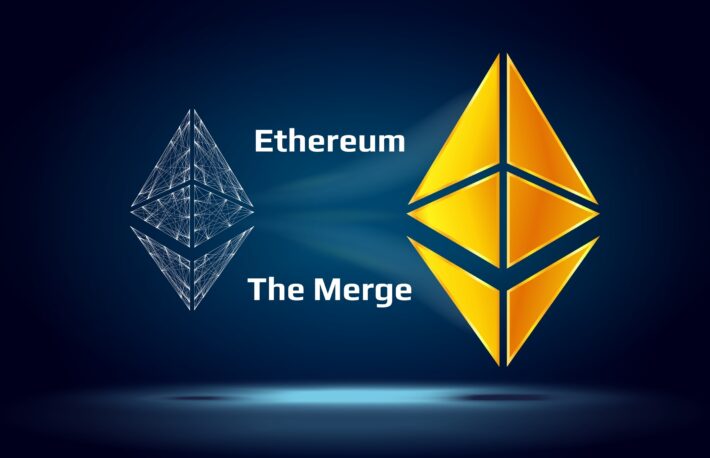
Ethereum merging is the most discussed and debated topic in the cryptocurrency space. Simply put, ETH or Ethereum Merge is the continued transformation of Ethereum’s consensus mechanism from its current Proof of Work to Proof of Stake. This transformation aims to address the issues faced by Ethereum related to scalability, energy consumption, and efficiency.
Are you curious about when this historic event took place? The integration is scheduled for September 15, 2022 , so you won’t have to wait that long. This upcoming schedule will bring great satisfaction to those who have been waiting for the past few years.
Let’s learn more about Ethereum Merge by leveraging the key components involved in Merge events.
#1.Beacon chain
The Beacon Chain is a parallel network chain developed to operate in parallel to the Ethereum mainnet. This chain started functioning in 2020. Proof-of-work mechanisms are being tested in beacon chains. The testing phase is very important for Ethereum before the merge. During the testing period, more validators were involved in improving Ethereum’s proof-of-stake consensus mechanism.
Beacon Chain cannot execute Ethereum smart contracts by itself. Therefore, the beacon chain is used to establish the functionality of the proof-of-stake mechanism.
#2.Ethereum merge
To complete the Ethereum merge, the beacon chain described above must be merged with the Ethereum mainnet.
During this process, the entire Ethereum network is converted into a proof-of-stake mechanism. Very comprehensive tests are performed beforehand to eliminate all errors.
#3.Shard chain
Finally, shard chains will be implemented to see increased scalability of Ethereum. A shard chain is an additional chain used to circulate the transaction load of the network. Apart from that, these chains allow more data on the network.
Initially, the shard chain was planned to run before the Ethereum merge. In contrast, Ethereum users have decided to focus on merge events. The execution of the shard chain will complete the entire event and is expected to occur around 2023.

What is the virtual currency halving period?
Halving is a deflationary phenomenon associated with blockchain. In this event, the rewards offered to validators will be half off. Bitcoin halving is one of the most popular in the cryptocurrency space.
For example, consider the case of Bitcoin. Bitcoin halving occurs once every four years. This halving event will work programmatically until the last Bitcoin is mined around 2040. The next Bitcoin halving is scheduled for around March 2024.
While the Bitcoin halving has been hotly debated, other cryptocurrencies such as Litecoin, Bitcoin SV, and Bitcoin Cash will also be halving. In contrast, the schedules of these cryptocurrencies are different from Bitcoin.
So, while keeping in mind the halving of virtual currency, let’s take a look at the triple halving.
What is triple halving?
The distribution of ETH based on the Proof of Work protocol is slightly different from the Bitcoin halving. Ethereum’s algorithm does not reduce the amount of ETH given to miners as a reward. This process is performed using software updates approved by the Ethereum community.
Members of the Ethereum community have dubbed this event the “triple halving.” This ETH issuance will take place after the “ETH merger” has taken place. According to current data, an average of 6,500 new ETH blocks are mined every day. Therefore, the merger increases miners’ rewards.
The three main parts involved in the 3x halving of ETH are:
#1. Significant decrease in ETH circulation volume
Ethereum issues approximately 13,500 ETH per day , and the annual issuance amount is equivalent to approximately 4.3% of the total ETH supply. Proof-of-stake (PoS) issuance is expected to reduce annual issuance by 0.3% to 0.4%.
The reduction in the annual issuance volume also reduces concerns about selling by ETH miners. Ultimately, a decrease in selling pressure will also lead to an increase in ETH price. The Ethereum economy will gradually move from a continuous “mine and dump” economy to a “stake and restake” economy.
#2. Writing ETH with EIP-1559
EIP-1559 is a major software update used to enhance Ethereum’s pricing system. EIP stands for Ethereum Improvement Proposal or London Hard Fork Update. EIP-1599 was implemented in the Ethereum system as a mechanism to introduce base fee burning.
Prior to Ethereum’s implementation of EIP-1599, many other cryptocurrencies, such as Polygon, added this update to their systems. Previously, users had to pay a base fee that was transferred to the miner. However, using EIP-1599 reduces the base fee on the circulating supply of ETH and increases its value.
Simply put, EIP-1599 enhances the Ethereum user experience. Along with users, miners’ incomes have also skyrocketed. Apart from that, the characteristics of the EIP-1599 system reduce the possibility of network attacks.
#3.Ethereum staking
Ethereum staking is the act of depositing ETH and receiving rewards (current annual interest rate is approximately 4.1%). Beacon Chain introduces upcoming Proof-of-Stake. Besides earning rewards, ETH stakers also benefit from better security. Let’s take a quick look at cryptocurrency staking for a deeper understanding.
As the number of ETH stakers increases, the Ethereum network becomes stronger and harder for attacks to carry out. If someone needs to attack the network, they need to keep most of the miners, which eliminates the possibility of an attack.
Compared to proof of work, proof of stake does not require complex system requirements. This benefit allows users to participate in proof of stake using a basic computer or smartphone. In addition to that, staking saves energy consumption and makes Ethereum more environmentally friendly.
Users can also use various staking options according to their convenience. The available Ethereum staking options are:
- solo home staking
- Staking as a service
- pooled staking
- centralized exchange
“Staking as a Service” and “Solo Home Staking” require you to deposit 32 ETH. 32 Are you comfortable staking your ETH? Then you can use “pooled staking” and “centralized exchanges” to lower your ETH staking.
Staking involves risks, so you should choose your staking options carefully.

How will the triple halving affect the scarcity of ETH?
The introduction of proof of stake is expected to reduce selling pressure by nearly 30%. The proof-of-stake mechanism encourages miners to sell their ETH once they receive their rewards. On the other hand, proof of stake and triple halving encourage miners to use their ETH rewards for staking activities.
Three halvings, roughly equivalent to Bitcoin’s three halvings, would reduce the ETH inflation rate from 4.3% to 0.43%. Apart from that, the daily block reward will also be reduced by a factor of 10.
To summarize, the result of a 3x halving of ETH would be:
- High network stability.
- A more secure and stable network.
- Increased scarcity of ETH.
- Less energy consumption.
conclusion
Without a doubt, the Ethereum merge is the biggest upgrade in the history of the cryptocurrency space. The Ethereum community is very optimistic about the outcome of this merger.
After a significant merge, Ethereum will become more scalable, secure, and consume less energy. However, as people expected, the merger will not lower gas prices. Apart from that, the merge will not improve Ethereum’s current transaction speed either.
If you are an ETH holder, you do not need to take any action during or after the merge. Upgrades are protocol based and have no direct impact to owners or users. All you have to do is sit back, relax and witness this historic event.
Also, check out some of the best Ethereum wallets.


![How to set up a Raspberry Pi web server in 2021 [Guide]](https://i0.wp.com/pcmanabu.com/wp-content/uploads/2019/10/web-server-02-309x198.png?w=1200&resize=1200,0&ssl=1)


