Computing has recently peaked and continues to grow. Over the past 30 years, machines have evolved and improved significantly, especially in terms of processing power and multitasking.
Can you imagine how much better performance would be if tasks were shared across multiple machines and executed in parallel? This is called distributed computing. It’s like computer teamwork.
But you may be wondering why we are discussing this distributed computing. Because distributed computing and Amazon EMR (Elastic MapReduce) are closely related. In other words, EMR by AWS uses distributed computing principles to process and analyze large amounts of data on the cloud.
Amazon EMR enables you to analyze and process big data using the distributed processing framework of your choice on S3 instances.
How does Amazon EMR work?

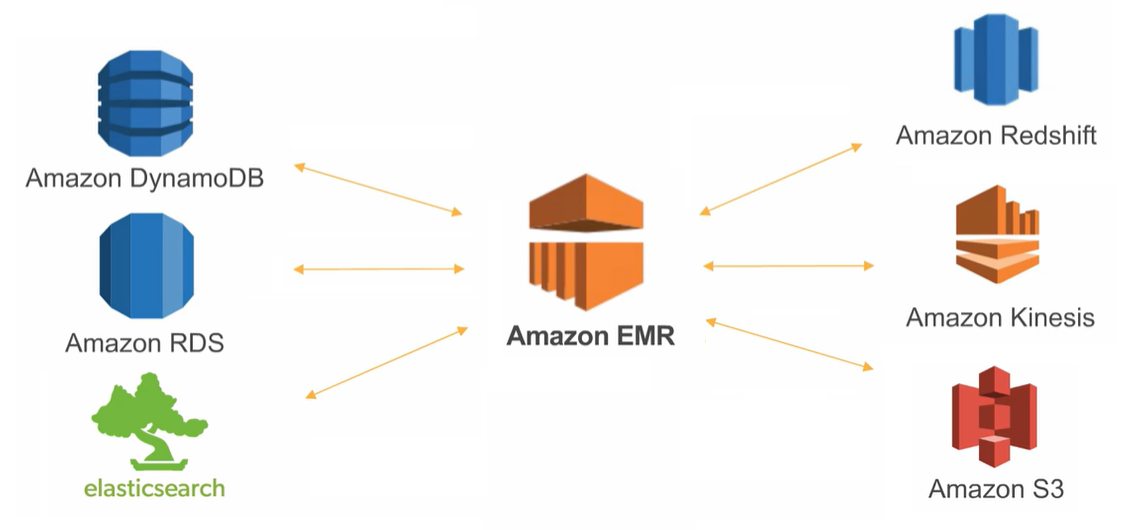
First, input your data into a data store such as Amazon S3, DynamoDB, or another AWS storage platform. All of these are well integrated with EMR.
Now, you will need a big data framework to process and analyze this data. With a variety of big data frameworks to choose from, including Apache Spark, Hadoop, Hive, and Presto, you can choose the one that suits your requirements and upload it to your data store of choice.
An EMR cluster of EC2 instances is created to process and analyze data in parallel. You can configure the number of nodes and other details to create a cluster.
Primary storage distributes the data and framework to these nodes, where data chunks are processed individually and the results are combined.
Once you have the results, you can terminate the cluster and release all allocated resources.
Benefits of Amazon EMR
Businesses of all sizes are always looking to implement cost-effective solutions. Then why not consider the affordable Amazon EMR? It simplifies running various big data frameworks on AWS and provides a convenient way to process and analyze your data while saving money.
✅Elasticity: You can infer its properties from the term “Elastic MapReduce”. What this term means – Amazon EMR makes it easy to manually or automatically resize your cluster based on your requirements. For example, you need 200 instances to serve requests today, but in an hour or two you might have 600 instances. Therefore, if you only need scalability to adapt to rapid changes in demand, Amazon EMR is the best choice.
✅Datastore: Whether it’s Amazon S3, Hadoop Distributed File System, Amazon DynamoDB, or any other AWS datastore, Amazon EMR seamlessly integrates with it.
✅Data processing tools: Amazon EMR supports various big data frameworks such as Apache Spark, Hive, Hadoop, and Presto. Additionally, you can run deep learning and machine learning algorithms and tools on top of this framework.
✅Cost-effective: Unlike other commercial products, Amazon EMR allows you to pay only for the resources you use on an hourly basis. Plus, you can choose from a variety of pricing models to suit your budget.
✅Cluster customization: The framework allows you to customize each instance of your cluster. You can also combine your big data framework with the perfect cluster type. For example, Apache Spark and Graviton2-based instances are a powerful combination for optimizing EMR performance.
✅ Access Control: You can control EMR permissions using AWS Identity and Access Management (IAM) tools. For example, you can allow certain users to edit clusters, while others can only view clusters.
✅ Integration: Integration of EMR with all other AWS services is seamless. This gives you the power of virtual servers, robust security, scalable capacity, and the analytical capabilities of EMR.
Amazon EMR usage examples
#1. machine learning

Analyze your data using Amazon EMR machine learning and deep learning. For example, running various algorithms on health-related data to track multiple health metrics such as BMI, heart rate, blood pressure, and body fat percentage is important for developing fitness trackers. All of this can be done faster and more efficiently on an EMR instance.
#2. Perform large-scale conversions
Retailers typically capture large amounts of digital data to analyze customer behavior and improve their business. Similarly, Amazon EMR can now use Spark to ingest big data and perform large-scale transformations efficiently.
#3. data mining
Do you want to deal with datasets that take a long time to process? Amazon EMR is purpose-built for data mining and predictive analysis of complex datasets, especially for unstructured data. Additionally, its cluster architecture is ideal for parallel processing.
#4. Research purpose
Complete your research using a cost-effective and efficient framework called Amazon EMR. Because of its scalability, you rarely experience performance issues when running large data sets on EMR. Therefore, this framework is highly adapted to big data research and analysis labs.
#5. real time streaming
Another big advantage of Amazon EMR is its support for real-time streaming. Build scalable real-time streaming data pipelines for online gaming, video streaming, traffic monitoring, and stock trading using Apache Kafka and Apache Flink on Amazon EMR.
How is EMR different from Amazon Glue and Redshift?
AWS EMR and glue
Two powerful AWS services, Amazon EMR and Amazon Glue, have a strong reputation for processing data.
Amazon Glue makes it fast and efficient to extract data from various sources, transform it, and load it into your data warehouse. Amazon EMR, on the other hand, helps you process big data applications using Hadoop, Spark, Hive, and more.
Essentially, AWS Glue allows you to collect and prepare data for analysis, and Amazon EMR allows you to process the data.
EMR and redshift
Imagine yourself consistently navigating through data and querying it with ease. SQL is often used to do this. Along the same lines, Redshift provides an optimized online analytical processing service that allows you to easily query large amounts of data using SQL.
When storing data, Amazon EMR enables highly scalable, secure, and highly available access using third-party storage providers such as S3 and DynamoDB. In contrast, Redshift has its own data layer and can store data in columnar format.
Amazon EMR cost optimization approach
#1. Comes with formatted data
The larger the data, the longer it will take to process. Furthermore, feeding raw data directly to the cluster makes the cluster more complex and takes more time to find the parts to process.
Therefore, formatted data comes with metadata about columns, data types, sizes, etc. that can save time when searching and aggregating.
Additionally, small datasets are relatively easy to process, so data compression techniques are used to reduce data size.
#2. Take advantage of affordable storage services
Leverage cost-effective primary storage services to reduce your core EMR expenses. Amazon s3 is a simple and affordable storage service for storing input and output data. With a pay-as-you-go model, you only pay for the storage you actually use.
#3. Appropriate instance sizing
Having the right instance with the right size can significantly reduce the budget you spend on EMR. EC2 instances are typically charged per second, and the price varies depending on their size, but whether you use a 0.7x large cluster or a 0.36x large cluster, their Management costs are the same. Therefore, efficient use of a large machine is more cost-effective than using multiple smaller machines.
#4. spot instance
Spot instances are a great option for purchasing unused EC2 resources at a discount. Compared to on-demand instances, these are cheaper, but they are not permanent as you can take them back when demand increases. Therefore, although they are flexible when it comes to fault tolerance, they are not suitable for long-running jobs.
#5. automatic scaling
Its autoscaling feature is all you need to avoid over- or under-clustering. This allows you to choose the right number and type of instances in your cluster based on your workload to optimize costs.
last word
Cloud and big data technologies are endless, and there are endless tools and frameworks to learn and implement. One single platform that leverages both big data and the cloud is Amazon EMR. Amazon EMR simplifies running big data frameworks for processing and analyzing large-scale data.
To help you get started with EMR, this article explains what it is, its benefits, how it works, use cases, and cost-effective approaches.
Next, check out everything you need to know about AWS Athena.


![How to set up a Raspberry Pi web server in 2021 [Guide]](https://i0.wp.com/pcmanabu.com/wp-content/uploads/2019/10/web-server-02-309x198.png?w=1200&resize=1200,0&ssl=1)


