Welcome to a complete review of two important monsters in databases: Apache Cassandra and MongoDB. Developers, get ready. We designed this article so that by the end you can make a rational decision about your upcoming trip.
Today, with the NoSQL database trend, most organizations are starting to adopt NoSQL databases. Among various other databases, Apache Cassandra and MongoDB stand out as the top choices for many.
Let’s start with an overview of Cassandra and then move on to MongoDB. Finally, it provides a clear guide for developers by comparing two popular NoSQL databases side by side in terms of data model, indexing, query language, transactions, concurrency, security, high availability, and scalability. I aim to do that. You can better understand the differences between them.
Let’s take a closer look at the kingdom of NoSQL databases and explore the strengths and features of two warriors: Apache Cassandra and MongoDB. Get ready for this exciting battle!
Apache Cassandra overview
Thousands of organizations seek availability and scalability without sacrificing performance when seeking the best platform for critical data flow and storage. The answer to this is Apache Cassandra .
Apache Cassandra is an open source NoSQL database. With features like linear scalability and security, I believe Cassandra has created a great space in the information technology market.
Another factor to consider is that Apache Cassandra supports low latency. This means it can survive an entire data center outage, and that too without data loss. That’s not the end. Cassandra can track DML, DDL, and DCL activity with minimal impact on workload performance.
To better understand Cassandra, it is essential to examine its history. Cassandra was developed by Avinash Lakshman to power Facebook’s inbox search capabilities. As the need for a powerful distributed database grew, Facebook released Cassandra as an open source project that later became the Apache Incubator project.
Cassandra combines features such as key-value databases and tabular databases for its data model. Data is stored in rows, and each row belongs to a table. The partition key and the remaining columns are the two parts of Cassendra’s primary key. This unique design allows efficient data organization within each partition and enables faster data access by allowing specific columns to be indexed independently.
You can control column sorting in your application for better organization. This particular approach enables efficient and scalable data retrieval in Cassandra’s distributed environment. More precisely, in Cassandra, a table is like a distribution map captured by key.
For better understanding, we have illustrated the main features of Cassandra. See image below.

To conclude this section about Apache Cassandra, it’s important to highlight one notable aspect: CQL (Cassandra Query Language). CQL has revolutionized user interaction with databases.
It is a simplified version of SQL with a user-friendly interface. CQL makes Cassandra more intuitive and accessible to everyone. Explore Apache Cassandra monitoring tools to closely observe database performance.
Let’s move towards MongoDB and explore its amazing strengths and features.
Mongo database overview
This section introduces MongoDB and its important information and features. MongoDB has a reputation as one of the most reliable databases and is a popular versatile choice for managing NoSQL data.
MongoDB was developed as a PaaS product by the American software company 10gen in 2007. The Mongo project then moved to an open source development model and was officially released on February 11, 2009. After some time, “10gen” changed its name to MongoDB Inc to reflect the database’s central focus.
MongoDB stands out for its flexible document-based data model that stores data in BSON (Binary JSON) format. This unique approach allows MongoDB to efficiently handle semi-structured and unstructured data, making it well-suited for applications with rapidly changing requirements. MongoDB has proven to be ideal for dynamic projects.
You can now run MongoDB using the MongoDB Atlas managed cloud service. Alternatively, you can choose MongoDB Community edition, which is open source and free.
For enterprise-level requirements, MongoDB offers the MongoDB Enterprise Advanced subscription. This subscription offers additional features, support, and advanced security options, making it ideal for businesses with mission-critical applications.
I’ve talked a lot about MongoDB so far, but there are some important aspects I want to highlight. That said, MongoDB supports concurrency through optimistic document-level locking. But that’s not all! MongoDB allows you to perform complex queries on your data.
What makes MongoDB a truly powerful and versatile database is its query language that can support a variety of operators, aggregations, and projections. These features and query capabilities make MongoDB a top choice for developers.
Next, we will discuss the main features of MongoDB that basically broadcast the conclusion. Follow the highlights below of the main features explained from an easy-to-understand perspective.
✅ Ad-hoc queries for real-time analysis with variable-dependent results.
✅ Proper indexing to optimize query execution and performance.
✅ Replication for enhanced data availability, stability, and disaster recovery.
✅ Sharding distributes large datasets across multiple shards to ensure scalability.
✅ Load balancing to handle concurrent read and write requests to improve performance and consistency.
Overall, MongoDB is a natural candidate for Apache Cassandra. Over time, MongoDB has proven to be reliable in every sense of the word. Developers personally love MongoDB for its performance and security. Now let’s move on to the battle of warriors and decide who will win.
Differences between MongoDB and Cassandra

Apache Cassandra and MongoDB are the most popular No-SQL databases with unique strengths and features. Cassandra follows a wide column store approach, while MongoDB is document-oriented.
MongoDB offers a variety of options for indexing, including single field, geospatial, composite, and text indexes, while Cassandra supports secondary indexes with some limitations. I would also like to emphasize that both databases have different query languages. Here, Cassandra uses CQL. MongoDB, on the other hand, utilizes MQL (MongoDB Query Language).
Cassandra’s distributed design and linear scalability are key benefits for high scalability and availability, while MongoDB supports replica sets for high availability. And while MongoDB stands out in the MongoDB Atlas when it comes to cloud products, Cassandra doesn’t have a dedicated managed service.
The choice between Cassandra and MongoDB depends on your application’s specific requirements and data management needs. Cassandra’s distributed architecture and high availability make it suitable for large-scale applications. Meanwhile, MongoDB’s flexible data model, powerful query language, indexing options, and support for ACID transactions make it a popular choice for a variety of use cases.
I decided to insert this section for better understanding and clarification. The differences are presented in a table format and serve as a useful guide.
| side | cassandra | Mongo DB |
| data model | wide column store | document oriented |
| Indexing | secondary index | Various indexing options |
| query language | CQL | MQL |
| transaction | No full ACID Txn | Multi-document ACID transmission |
| availability | distributed data replication | replica set |
| Scalability | linear | horizontal |
| safety | Authentication and authentication | Role-based access control |
| data visualization | No native tools | third party tools |
| Aggregation framework | limited | sturdy |
| secondary index | Performance comes with some trade-offs | wide range of options |
The table above provides a concise comparison of the main differences between Cassandra and MongoDB. The choice between the two databases depends on your specific use case requirements and preferences.
last word
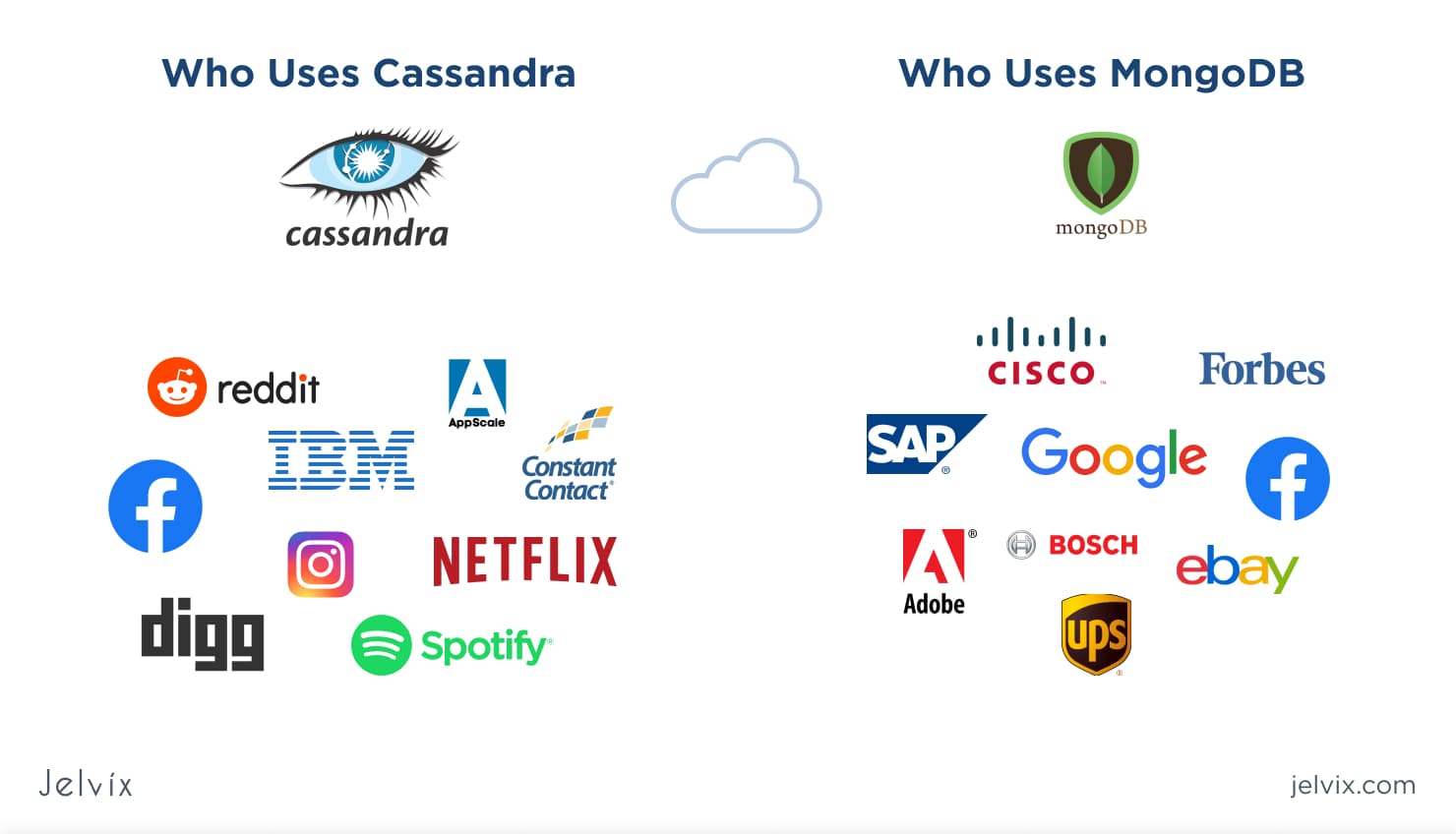
Different organizations rely on both databases depending on their requirements. Organizations like Apple, Netflix, Airbnb, and Uber use Apache Cassandra as their database.
Meanwhile, companies like Adobe, IBM, Bosch, and LinkedIn have trusted MongoDB in their efforts. The future is bright for both databases as Cassandra will undoubtedly continue to grow in the IoT space. Meanwhile, the future of MongoDB is likely to include the integration of machine learning capabilities that enable advanced data analytics and predictive modeling within the database.
Both Cassandra and MongoDB are expected to continue evolving and expanding their capabilities to meet the growing demands of modern data-driven applications and provide even better solutions for enterprises and developers around the world. Masu. The choice depends on your specific needs and scalability requirements. So choose wisely.
Then check out our detailed article on MongoDB vs. MariaDB vs. MySQL.


![How to set up a Raspberry Pi web server in 2021 [Guide]](https://i0.wp.com/pcmanabu.com/wp-content/uploads/2019/10/web-server-02-309x198.png?w=1200&resize=1200,0&ssl=1)


