Serverless frameworks have been in demand for the past few years and are seeing increasing adoption among developers.
Nevertheless, container-based applications are already popular, and so is Kubernetes among enterprises.
Kubernetes is definitely a great tool with great potential. That ecosystem is growing with a variety of new tools and emerging technologies, including Knative, which has the power to further improve Kubernetes.
Knative was introduced to overcome the roadblocks and establish core standards for cloud platforms and cloud-native orchestration.
In other words, the Knative serverless framework can fit your enterprise’s needs much better than other cloud-based serverless deployments.
This guide describes Knative, its benefits, use cases, installation instructions, working instructions, and more.
Let’s go!
What is a native?
Knative is a Kubernetes-based serverless framework originally developed by Google. It loads and runs serverless functions based on your company’s requirements, minimizing waste. This is an open source project that adds components for deploying, running, and managing serverless applications on Kubernetes.
The main purpose of the Knative serverless framework is to manage cross-platform orchestration standards. This is achieved by integrating container creation, autoscaling, event models, and workload management capabilities.

Previously, there were various open source solutions besides Knative. Each solution has its own method of deployment, and the lack of standardized practices can lead to market fragmentation. This means that if you need specific system features, you need to choose a specific provider.
But immigration issues began to surface. To avoid such problems, the Knative serverless framework was introduced. So even if a task is difficult to incorporate, Knative allows you to perform it efficiently within a Kubernetes-based pipeline.
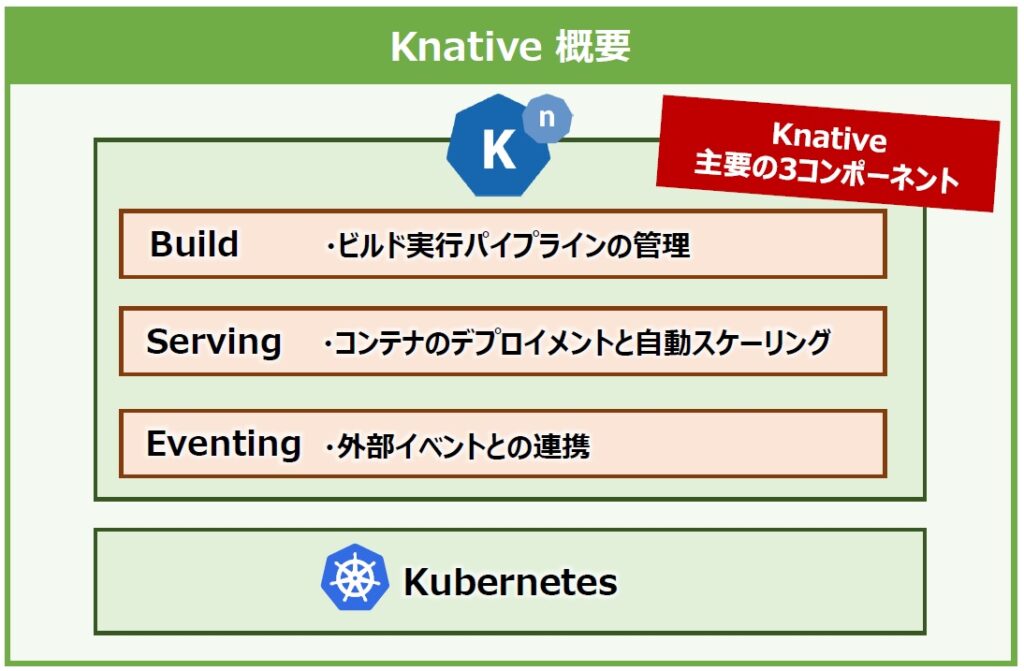
Knative has three parts.
- Knative Build: Builds a container image and makes it available from source code.
- Knative Serving: Use Istio and Kubernetes to connect and deploy these container images through allocated infrastructure resources.
- Knative Eventing: Allows users to define event triggers and associate event triggers with containerized functions.
Whenever Knative identifies an event, it defines an associated process that executes that event on demand. Knative only commits hosting resources when specific processes run, so you don’t have to allocate container nodes, clusters, or pods for work. In this way, Knative balances the benefits of serverless and containers.
Knative core concepts
Describes the main concepts of the Knative Serverless Framework and how they relate to Knative primitives.
build
Knative construction helps you leverage and extend existing Kubernetes primitives, allowing you to run container builds from origin. Enable dependencies and source code from your repository, build and register your container image.
event
/filters:no_upscale()/news/2019/09/cloudstate/ja/resources/image1-1568022115521.png)
This event helps create better communication between loosely coupled event consumers and producers to build event-driven architectures. Knative queues these events that should be executed automatically without developer scripts.
These events are then delivered to the container. Then send the feed to the event producer to perform the task. This reduces the workload of developers writing code to establish connections.
function
Functions are independent units of deployment and Knative service delivery services, similar to microservices. That code is written to perform a single task like this:
- Process files in the database
- Save user to database
- Run scheduled work
The Knative serverless framework is designed to help you effectively develop, deploy, and manage functionality.
plugin
You can easily extend or override the functionality of the Knative serverless framework using plugins. Every serverless.yml file contains plugin properties that feature various plugins.
resource
Resources are Knative serverless infrastructure components used by functions, including:
- AWS SQS event source
- Scheduled tasks (run every 5 minutes, every 10 minutes, etc.)
- Kafka event source
more.
service
Services are like projects. Therefore, a service is the organizational unit of the Knative serverless framework. Although a single application can contain many services, you can think of services as project files.
Here, functions, events, and resources can all be defined in a single file named serverless.yml , serverless.json , or serverless.js . When you deploy a service using a serverless framework, everything in the file is deployed at once.
waiter

Knative-serving is built into Istio and Kubernetes to support application deployment. This enables rapid development of serverless containers, network programming, and autoscaling of Istio components. Knative-serving considers containers as scalable services ranging from one instance to many container instances.
Features of Knative

Learn about some of the features of the Knative serverless framework.
- Knative is a Kubernetes-based serverless framework that allows you to deploy services on Kubernetes.
- Easily integrate Knative with supported environments
- Knative allows developers to use Kubernetes APIs directly to deploy serverless services.
- Users can leverage Knative’s event system to trigger serverless services.
How does Knative work?
The Knative serverless framework acts as the event steering segment and connects Istio and Kubernetes. Kubernetes acts as an orchestrator for microservices and containers. Istio, on the other hand, is an open-source mesh technology that integrates various components to interact with users and themselves.
Knative provides users with multiple components aimed at performing basic daily tasks. These components are used repeatedly in different applications. Developers can use any programming language. Therefore, Knative only recognizes container images and does not require any special knowledge of the language.
The Knative serverless framework has three components that are key to its functionality.
Building a new container

The build component is responsible for building new containers. You can convert your source code into a container. Knative can be configured to meet the specific needs of your business.
First, Knative pulls source code from libraries such as Github. Next, underlying dependencies are added so that the code runs effectively. Next, a container image is built and placed in a file that the Kubernetes platform can access.
Containers will be available to developers using Kubernetes and Knative. So as long as the origin of the code is known, the container will be built.
Providing or running a platform
The service provision component is responsible for running the platform. It includes:
- Configuration: Configuration is robust when managing multiple versions of a service. Whenever a new feature of a container is deployed, Knative saves the existing version and creates a new version with the latest changes and features. Additionally, Knative defines the state of the service.
- Autoscaling: For serverless containers to work better, they should be able to scale up or down automatically. Knative can autoscale your services to large numbers as needed.
- Intelligent service routing: This is a key part of Knative’s working mechanism. This allows developers to direct the flow and volume of traffic to different existing versions of a microservice. Use intelligent service routing while introducing new features and blue-green deployment strategies.
This allows you to expose some users to the latest tests and versions, and gradually route huge traffic to newer versions.
Eventing to define functions

Knative’s event component is responsible for describing Knative’s functionality. You can define container execution based on events. Various events trigger specific functionality in the container.
Developers can define event triggers and associated containers to let Knative do the job. Knative handles event listing and event delivery.
native advantage
Knative provides services such as route management, phased releases, and service connectivity. It boasts a vast community. Let’s discuss how Knative can influence companies to adopt this technology.
- Unlike other solutions, Knative has standard events and is compatible with FaaS solutions. Provides the CloudEvent standard framework to help you design serverless architectures.
- Knative is not a PaaS, but you can use a serverless orchestration platform to create a serverless PaaS.
- Knative has a professional and mature serverless design.
- Eliminate the possibility of locking vendors into specific solutions by supporting cross-platform and providing common standards across cloud providers.

- Knative provides a flexible framework.
- Supports proportional phased releases.
- Experience a serverless ecosystem within a containerized environment.
- Knative eliminates administration and tool reliability.
- By implementing Kubernetes, you can quickly migrate to other cloud providers that integrate with Knative.
- Provides a request-driven computing model.
- You can manage your workflows as a service.
- Knative allows you to process IoT data, perform accessibility checks, and validate security group configurations.
- This allows developers to focus on coding and create iterative code quickly.
- This ensures that developers can incorporate new versions.
- Knative’s event-based model helps you implement designs such as subscriptions, connections to external systems, and registration.
Knative challenges (and some solutions)
Efficiency challenges
With the right application support, Knative Framework provides better performance at minimal cost. However, the wrong mix of applications can result in high costs and underutilization of container resources. This can lead to poor application performance, which is the biggest challenge with Knative serverless deployments.

Therefore, an incorrectly sized resource pool or the wrong application can negate many of the benefits of Knative.
You can overcome this challenge by running tests in Knative that validate resource amounts and application combinations. Measure the event load by sizing the average and maximum loads of each to estimate the total resource consumption. Repeat this for several applications, create and run trial configurations, and verify your estimates.
functional challenges
Knative’s functional challenges are:
- Knative relies on functions that fit stateless models. This means that the component itself does not store any data. Developing a feature is not a difficult stage, but it requires a slight change in approach, and a single mistake can ruin the performance of the software.
- Business data consists of multi-step transactions, and stateless functions maintain context across all steps. Knative lacks the functionality found in serverless tools in public clouds.
By regularly monitoring and fixing problems, you can keep your performance at a good score.
Operational challenges

Compared to public cloud serverless offerings, Knative presents operational challenges. Administrators do not control the underlying servers in the public cloud. However, you will need to manage servers along with Kubernetes, containers, Knative, and Istio itself.
Knative minimizes operational and development complexity for companies already working with Kubernetes and containers. Those who are passionate about service mesh and microservices will find Knative a natural extension.
Examples of using Knative

For applications that fire events that vary within or beyond set limits in time, Knative is the best choice. Here are some specific use cases for the Knative serverless framework:
- Website testing and validation
- Application monitoring
- IoT
- network monitoring
- Mobile application front-end process
- Agile and DevOps lifecycle
- New feature rollout
- Streamline Kubernetes
Event orientation is essential. If your IT team can’t imagine applications as sequences of events rather than transactions, Knative may not be the right choice for functionality and efficiency reasons.
Knative prerequisites and installation
As explained in the section above, Knative is a set of components such as event processing and serving that run on top of service meshes and workload orchestration clusters. For easier operation, there is a command line utility that you need to install. Therefore, some dependencies are required to ensure the installation can proceed.
Prerequisites
There are several options for installing Kubernetes. Docker Desktop enables easy Kubernetes clusters for a variety of purposes. A simple approach is to use Kubernetes with Docker to run a Kubernetes cluster along with Docker container nodes. A convenient way to work with clusters is to use the Knative command line tools.
Knative CLI provides an easy and quick interface for creating resources. Useful for complex tasks such as traffic splitting and autoscaling. A convenient method is to download compatible binaries from the GitHub page .
install
Once all prerequisites are met, you can proceed to install the components. There is a quickstart plugin for your development environment. This plugin helps you install a local Knative cluster using the Knative client. The quickstart plugin can be downloaded from the official release page.
Conclusion: The future of Knative
Knative replaced serverless computing by providing automatic scaling of applications. This has major implications for interoperable modular systems.
In the future, it is hoped that Knative will cover its current shortcomings and become one of the most efficient technologies for running serverless architectures.
Knative technology has more impact for developers considering its benefits compared to serverless alternatives. Knative eliminates the need to build and maintain Kubernetes extensions, saving you a lot of time. Developers are very happy with Knative technology because it is easy to use and a great alternative to serverless solutions.
So, if you want to take full advantage of the power of a Kubernetes environment in your cloud workflows, adopt Knative technology and experience the benefits for yourself.


![How to set up a Raspberry Pi web server in 2021 [Guide]](https://i0.wp.com/pcmanabu.com/wp-content/uploads/2019/10/web-server-02-309x198.png?w=1200&resize=1200,0&ssl=1)


