After the Snapdragon 8 Gen 3 announcement, all eyes are on whether Qualcomm can finally beat Apple in the chip race. The Apple A17 Pro was released a month ago, but now that we’ve got the latest flagship chip from Qualcomm, it’s time to pit them against each other. This comparison of Snapdragon 8 Gen 3 and A17 Pro compares the performance improvements in CPU, GPU, NPU, ISP, modem, and more.
Geekbench benchmarks for both Snapdragon 8 Gen 3 and Apple A17 Pro are also included. So, without wasting any time, let’s take a look at the detailed comparison.
Specification table
| specification | Snapdragon 8 3rd generation | apple a17 pro |
|---|---|---|
| CPU | Octa-core, Kryo CPU | 6-core CPU, 19 billion transistors |
| CPU core | 1x 3.3GHz (Cortex-X4) 3x 3.2GHz (Cortex-A720) 2x 3.0GHz (Cortex-A720) 2x 2.3GHz (Cortex-A520) | 2x 3.78 GHz high performance cores 4x 2.11GHz high efficiency cores |
| process technology | TSMC’s 4nm process | TSMC’s 3nm process (N3B) |
| GPU | New Adreno GPU (750?) Unreal Engine Global Illumination | Apple Pro Class 6-core GPU hardware-accelerated ray tracing |
| memory support | LPDDR5X, up to 4.8GHz | LPDDR5 |
| Machine learning and AI | New Hexagon AI Engine | 16 core neural engine. 35 tops |
| ISP | New cognitive ISP | Image signal processor designed by Apple |
| camera function | Up to 12 layers of semantic segmentation Dual camera experience Dolby HDR capture | ProRAW photos with 48MP Photonic Engine |
| video function | Night vision for dark scenes | 4K60 ProRes Video Spatial Video Recording 4K HDR Dolby Vision @ 60FPSCinematic 4K@24FPSA Action Mode |
| modem | Snapdragon X75 5G Modem Up to 10 Gbps Peak Download Up to 3.5 Gbps Peak Upload | Snapdragon X70 5G Modem Up to 10 Gbps Peak Download Up to 3.5 Gbps Peak Upload |
| Wi-Fi support | Wi-Fi7 | Wi-Fi 6E |
| bluetooth | Bluetooth 5.4, LE AudioDual Bluetooth antenna aptX lossless | bluetooth 5.3 |
| others | AV1 codec supportNavIC supportSnapdragon Seamless | AV1 DecoderProRes Codec Pro Display Engine NavIC Support |
CPU: 8 cores vs 6 cores
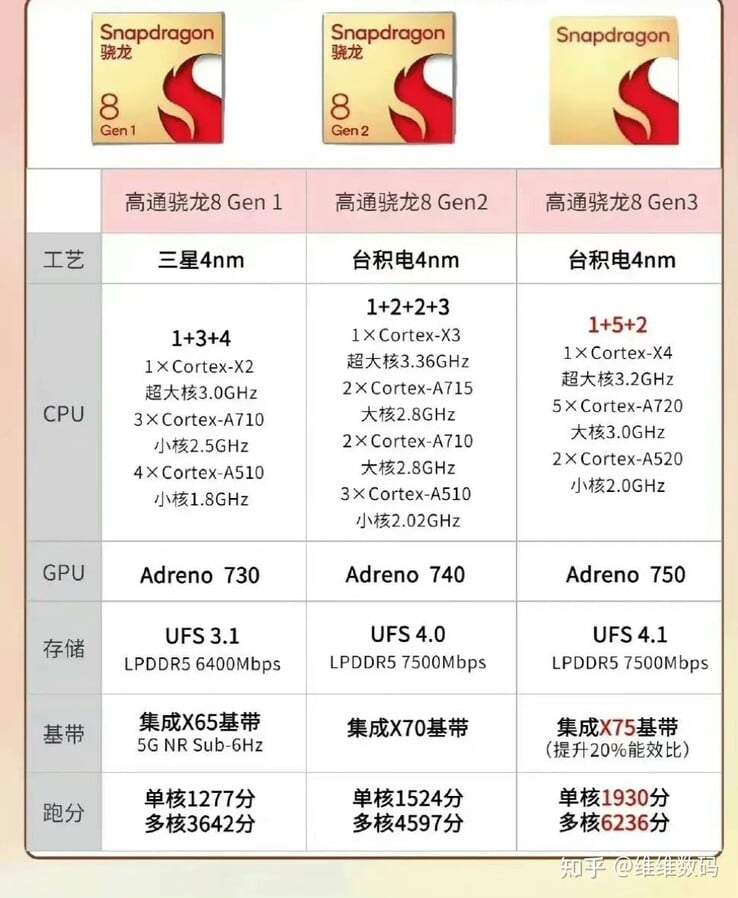
First, let’s compare the Snapdragon 8 Gen 3 and Apple A17 Pro CPUs. Snapdragon 8 Gen 3 is manufactured on TSMC’s 4nm process node and features an octa-core design. Although it uses upgraded Kryo cores , Qualcomm did something different this year when it comes to core cluster design. The American chip maker has a single prime core (Cortex-X4 clocked at 3.3 GHz), three Cortex-A720 cores clocked at 3.2 GHz, and two Cortex-A720 cores clocked at slightly below 3.0 GHz. Clockwise, the two Cortex-A520 cores are clocked at 3.0 GHz. 2.3GHz.
A total of five Cortex-A720 cores are used, all clocked at 3.0 GHz or higher. Cortex-A520 cores have been reduced to just 2 cores. ARM’s performance cores appear to be superior in both performance and efficiency. Qualcomm says Snapdragon 8 Gen 3 is 30% faster and 20% more efficient than its predecessor, Snapdragon 8 Gen 2 .
Moving on to the Apple A17 Pro, it’s built on TSMC’s 3nm process node , which allows Apple to pack over 19 billion transistors onto a single die. Unlike 8Gen3’s 8-core CPU, A17 Pro features a 6-core CPU with 2 high-performance cores clocked at a powerful 3.78 GHz and 4 high-efficiency cores clocked at 2.11 GHz . The design of the CPU cluster shows that Apple has an impressively large core with a much higher maximum frequency than the Cortex-X4.
There is no doubt that the A17 Pro scores much higher than the Snapdragon 8 Gen 3 in the single-core test. However, as evidenced by Qualcomm’s official numbers below, the Snapdragon 8 Gen 3 scores higher than the A17 Pro in the multi-core test. That said, keep in mind that Qualcomm uses 8 cores, while Apple crosses the 7K mark with just 6 cores. Apple truly has amazing CPU cores with exceptional performance and efficiency.
Snapdragon 8 Gen 3 and A17 Pro: Benchmarks
geek bench 6
In the leaked Geekbench 6 list of the next Xiaomi 14 equipped with Snapdragon 8 Gen 3, it scores 2207 points in the single-core test and 7494 points in the multi-core test. As stated in our article, Snapdragon 8 Gen 3 benchmark Article, Qualcomm’s reference device scored 2329 in the single-core test and 7501 in the multi-core test .
In comparison, the A17 Pro scores 2897 for single-threaded tasks and 7261 for multi-threaded tasks. For the first time, Qualcomm was able to outperform Apple in a multi-core CPU test. The next Snapdragon chips with Oryon cores next year could also beat Apple in single-core tests, hopefully with fewer cores. SoC Single core (Geekbench 6) Multicore (Geekbench 6) apple a17 pro 2897 7261 Snapdragon 8 Gen 3 (Qualcomm QRD device) 2329 7501 Snapdragon 8 Gen 3 ( Leak ) 2207 7494
AnTuTu Benchmark
In the AnTuTu benchmark, Snapdragon 8 Gen 3 received an impressive score of 2139,281 points , exceeding 2 million points. In comparison, the A17 Pro scored just 1628672 points in the AnTuTu test. SoC AnTuTu score Snapdragon 8 3rd generation 2139281 A17 pro 1628672
3DMark Wildlife
In 3DMark WildLife tests that evaluate GPU performance, Snapdragon 8 Gen 3’s powerful new Adreno GPU redefines what’s possible in a mobile GPU. The Snapdragon 8 Gen 3 scored 5338 points at 32 FPS in the intensive WildLife Extreme test, while the A17 Pro scored 4075 points at 24.4 FPS.
In the 3DMark Solar Bay test, which tests its ray-tracing capabilities, the Snapdragon 8 Gen 3 once again took the lead with a score of 8547 points and 32 FPS . In contrast, the A17 Pro scored 6594 points at 25.1 FPS. Qualcomm has once again proven that there is nothing on the market today that can match its Adreno GPUs. SoC 3DMark Wildlife Extreme 3DMark Solar Bay Snapdragon 8 3rd generation 5338 score / 32 FPS 8547 score / 32 FPS A17 pro 4075 score / 24.4 FPS 6594 score / 25.1 FPS
GPU: Is Adreno 750 better?
In the graphics department, the latest Adreno 750 GPU on 8 Gen 3 received a nice upgrade this year, and most importantly, it’s even more efficient. Qualcomm says the new Adreno GPU is 25% more powerful and 25% more efficient than last year’s 8 Gen 2 chipset. 8 Gen2’s Adreno 740 GPU already matches Apple’s GPU performance at much lower power. And with improved performance and efficiency, the new Adreno GPU could deliver better results.
Separately, Snapdragon 8 Gen 3 now supports the Unreal Engine 5 Lumen system with global illumination. This gives you better and more accurate reflections, as well as console-level graphics. On top of that, Adreno GPUs support hardware-accelerated ray tracing and introduce the new Adreno Frame Motion Engine (AFME 2.0) to upscale 60FPS graphics to 120FPS in real-time . Not to forget, there’s support for 240Hz displays, so you’ll be able to run 240FPS games on the Snapdragon 8 Gen 3 without any issues.
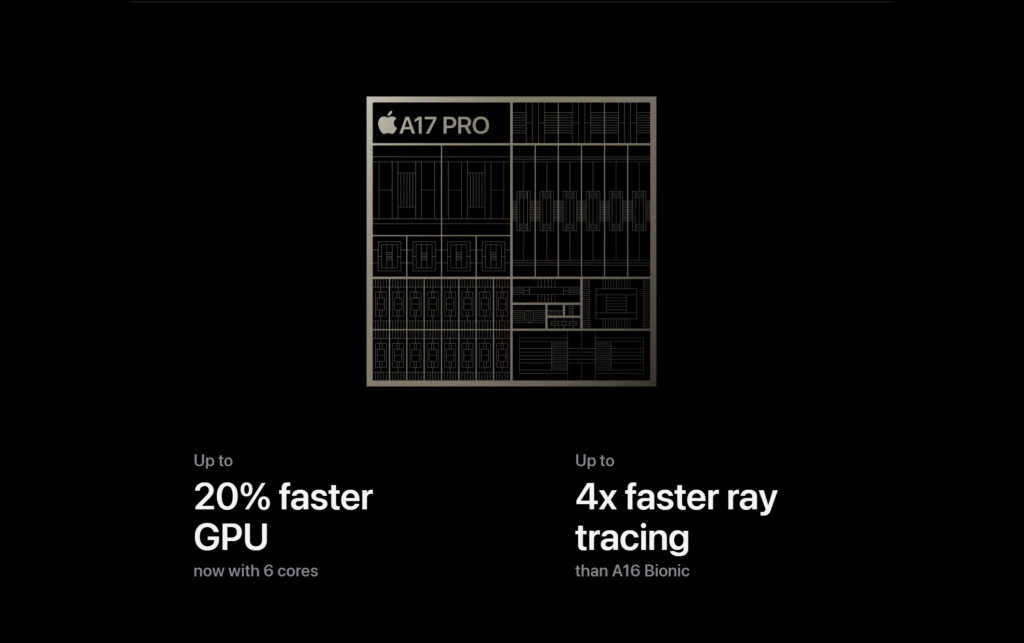
Meanwhile, Apple has moved to a 6-core GPU design with the A17 Pro, which is based on the new Shader architecture. Apple also introduced support for hardware-accelerated ray tracing to bring gameplay to console level. The latest iPhone 15 Pro models can play AAA games like Resident Evil Village, Death Stranding, and Assassin’s Creed Mirage. Similar to Snapdragon’s AFME, Apple introduced MetalFX Upscaling to improve the frame rate of the A17 Pro.
That said, many tests point out that the new 6-core GPU falls short in terms of efficiency. It draws nearly 11W of power, matching the peak performance of the older 8 Gen 2’s Adreno 740 GPU. On his YouTube channel , Geekerwan measured the power consumption of the new 8 Gen 3 Adreno GPU on the Xiaomi 14 and the A17 Pro 6-core GPU on the iPhone 15 Pro. The results show that the A17 Pro’s GPU peaks at 10.9W, while the Adreno GPU scores higher at just 8.2W .
In terms of both performance and efficiency, the Snapdragon 8 Gen 3’s Adreno GPU outperforms the A17 Pro’s 6-core GPU. We’ll have to use both devices extensively to see how they perform in real life, but so far it looks like Qualcomm has once again outperformed Apple .
AI and neural engine upgrades
Qualcomm has done a great job introducing generative AI capabilities to Snapdragon 8 Gen 3 this year. We built a new Hexagon AI engine that is 98% faster and 40% more efficient than previous generation NPUs. Qualcomm says the new AI engine can run AI models locally and generate up to 20 tokens per second .
The new Hexagon NPU can run 3B to 13B AI models on your device and deliver private, personalized experiences. The company has partnered with Meta to commercially use its Llama 2 model on 8th Gen 3-powered devices. Apart from that, you can run other AI models optimized for the Snapdragon platform.
In addition to that, when it comes to image synthesis, it is very impressive that the Hexagon AI coprocessor can generate images in less than a second . Qualcomm says its NPUs can use CPUs, GPUs, NPUs, high-speed memory, and Qualcomm Sensing Hubs to process multimodal data and deliver personalized AI experiences.
Apple has also done a great job in the AI and ML department with the A17 Pro. The 16-core Neural Engine provides 2x better performance than the previous generation AI Engine. It can effectively perform 35 trillion operations per second (TOPS), which is certainly impressive. TOPS numbers for 8 Gen 3 are unknown, but the Hexagon AI engine in Snapdragon X Elite, Qualcomm’s latest chip designed for PCs, can run 45 TOPS.
Qualcomm reiterated that both numbers cannot be compared as both platforms have different AI engines. But Apple and Qualcomm appear to be in a close race to become the hardware platform that runs AI models.
ISP and camera features
This year, Snapdragon 8 Gen 3’s ISP has gotten a lot smarter. Qualcomm calls this Cognitive ISP, which can perform real-time semantic segmentation of up to 12 layers. Isolate objects and different scenes from your images and apply accurate colors to match the scene. Besides that, you can also remove objects from captured videos , use AI to enlarge captured photos, and use Night Vision AI to improve the brightness and clarity of dark videos. Masu.

Along with that, you also get simultaneous support for front and rear cameras to record your vlogging experience. Qualcomm also offered Dolby HDR photo capture with over 1 billion shades of color compared to JPEG’s 16.7 color shades.
Moving to ISP on the A17 Pro lets you shoot 4K 60FPS ProRes video , ProRAW images, and even spatial video that can be viewed with Apple Vision Pro. It has a capable ISP that works in conjunction with the Photonic Engine to provide clear and accurate images. Overall, both ISPs are very powerful, but the one with 8 Gen 3 AI is better.
wireless connection
With Snapdragon 8 Gen 3, Qualcomm uses its own Snapdragon X75 5G modem . Get peak download speeds of up to 10 Gbps and upload speeds of up to 3.5 Gbps. It comes with Wi-Fi 7, Bluetooth 5.4, and LE for local connectivity.
The Apple A17 Pro uses Qualcomm’s X70 5G modem, which is a separate modem while the 8 Gen 3 has an integrated modem. On top of that, you also get Wi-Fi 6E and Bluetooth 5.3 support. So, in terms of connectivity, the Snapdragon 8 Gen 3 and A17 Pro are on roughly equal footing.
Verdict: Snapdragon 8 Gen 3 or A17 Pro?
Looking at the specs on paper, the Snapdragon 8 Gen 3 appears to have received significant upgrades in every aspect. It can’t beat Apple A17 Pro in single-threaded CPU tasks, but it beats Apple’s stronghold in multi-core CPU tasks. Add in an efficient GPU, a powerful AI engine, an AI-powered ISP, and modern connectivity options, and you get an overall great package.
That said, we need to run more tests and monitor real-world performance before we can fully conclude our verdict. Stay tuned as we bring you more benchmark numbers for Snapdragon 8 Gen 3. In the meantime, check out the comparison between Apple A17 Pro and Snapdragon 8 Gen 2 and share your thoughts in the comments section below.


![How to set up a Raspberry Pi web server in 2021 [Guide]](https://i0.wp.com/pcmanabu.com/wp-content/uploads/2019/10/web-server-02-309x198.png?w=1200&resize=1200,0&ssl=1)


