With increasing customer acquisition costs and decreasing lead conversion rates, revenue is at the center of business transformation. With the RevOps model, companies are achieving new levels of growth, and you can too.
The Revenue Operations or RevOps business model creates integrated marketing, sales, and customer service teams. Businesses, especially B2B organizations, are rapidly adopting this model to drive increased team productivity and ROI.
If you want to learn about RevOps, you’ve come to the right place. Let’s get straight to the point.
What is RevOps?
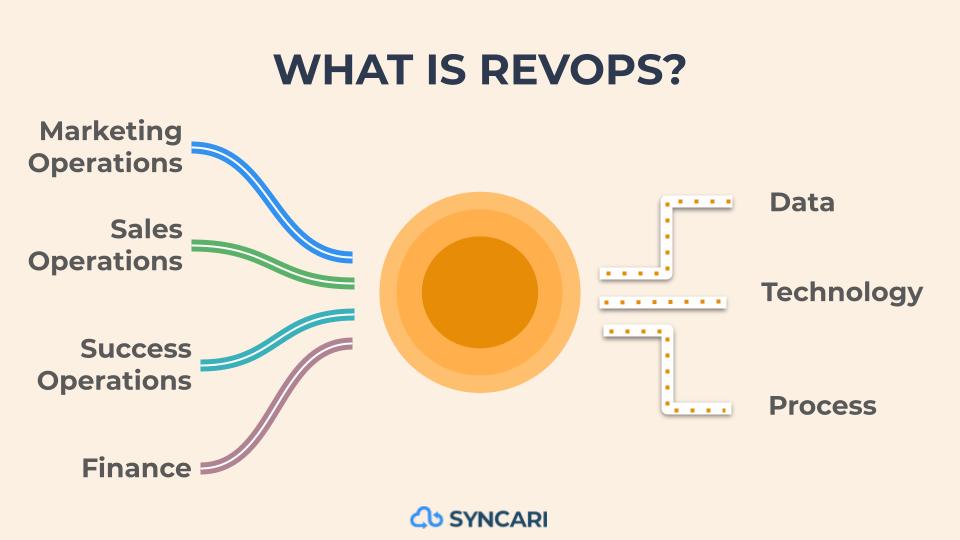
The Revenue Operations or RevOps model refers to the combination of a company’s sales, marketing, and customer success teams working to achieve a unified revenue process. This process integrates marketing funnels, sales processes, and customer retention strategies, combining data, goals, and processes.
RevOps aims to dramatically increase revenue while simultaneously achieving end-to-end accountability and visibility. By doing so, your revenue team will be able to build trust with your customers. This process includes major changes in strategy, implementing RevOps roles, and using RevOps tools.
Why do companies choose RevOps?

In traditional businesses, multiple departments operate with separate missions. There was no connection between customer experience and other teams, and no unified analytics data was available. It was a time when companies could only hope for increased profits.
With the introduction of the RevOps model, companies can now implement strategies across their organizations to increase revenue.
The main reasons why companies adopt a revenue operating model are:
- Marketing technology is becoming increasingly important in today’s business environment.
- The need for integrated management across marketing, sales, and customer service.
- Demand for connected, personalized customer experiences at scale.
Additionally, companies choose to implement RevOps to avoid lack of visibility into bottlenecks, operational inefficiencies, discontinuities in customer experience, and lack of insight into revenue generation potential.
Benefits of RevOps

Predictability of growth
With RevOps, organizations can get the accurate revenue growth forecasts they are looking for. With such a forecast, it becomes possible to design a reasonable blueprint for revenue generation. You can also use predictive data to plan and test marketing, investment, and other strategies.
Collaboration between teams
When teams work together, new revenue opportunities emerge through innovation. RevOps allows cross-functional teams to work together, find solutions to problems from new perspectives, and achieve goals quickly and effectively.
enthusiastic employees
In a RevOps environment, clear and collaborative goals align with the organization’s larger goals. Employees stay motivated at work because they know what the company expects of them and how they can contribute to the company’s success.
cost reduction
Companies that implement a RevOps strategy can significantly reduce their cost-to-market. Efficient processes, resource allocation, accurate forecasting, and connected teams are the features of RevOps that are responsible for reducing costs.
transparency
With RevOps, businesses get a centralized data system that can be used as a single source of truth. All inconsistencies and data gaps are eliminated, allowing businesses to perform data-driven activities with confidence.
Improving customer satisfaction
Satisfaction at every stage of the customer journey is essential for customer retention and loyalty. RevOps can internally align all teams and customers to deliver benefits such as faster response times, personalized offers, and more thoughtful engagement.
Difference between Sales Operations and RevOps

RevOps is a relatively new concept to Sales Ops, so some readers may find it confusing. However, these are different models and in this segment we will discuss how they differ from each other.
Sales Ops teams primarily focus on sales, while RevOps teams focus on multiple areas such as marketing, sales, and customer service. The former team works solely on increasing revenue from sales, while the latter team can drive revenue growth for the company as a whole.
Many companies already have a Sales Ops team, but most are still new to RevOps. If your company already has a Sales Ops team, you can also incorporate a RevOps team. Your sales team can focus on selling, and your RevOps team can work behind the scenes collecting and managing data.
Key RevOps metrics

If you want to measure the success of your RevOps policy or team, you should be aware of the following metrics:
revenue
Revenue is the primary goal of RevOps and the primary metric for measuring its success. The amount of money a company generates by selling a product within a certain period of time.
sales cycle length
The sales cycle refers to the time it takes from the first contact with a potential customer to the completion of a purchase.
For B2B companies, the length of this cycle can be longer as the product requires a large investment and the client takes a long time to decide. However, your goal should be to keep the length as short as possible while maintaining the quality of the customer experience.
pipeline leads
Pipeline can predict future revenue and should be measured regularly to identify and address issues before they are reflected in sales numbers. Qualified leads indicate whether your marketing and sales teams are reaching the right audience.
customer lifetime value
This is because acquiring new customers costs more than retaining existing customers. With the proliferation of subscription-based business models, companies are focusing on customer retention to increase revenue. As a result, customer lifetime value has become central to a company’s overall revenue potential.
retention
Retention rates give you an idea of the health of your company’s customer base. Indicates whether the customer is satisfied with the service. Retention should be on every team’s priority list.
Pillars of RevOps
The RevOps business model consists of three pillars or foundations. Companies need to make sure everything is established for clarity and accountability across the team.

1. Process
A process refers to the sequence of actions required to achieve a goal. This is a framework that includes procedures, resources, and technology that your team must follow.
Processes with clearly defined procedures and steps facilitate a great customer experience and cross-departmental interactions. You can regularly evaluate each step to determine if improvements are needed.
2. Platform
All existing tools and technologies sync to collect accurate revenue information. To get a real-life scenario, you need to connect your company’s tools to your revenue funnel. With one source of truth, your team can easily see the big picture and evaluate their work.
3. People
The final pillar of this process is the person responsible for coordinating and overseeing the other pillars. Depending on the size of your organization, you can create a dedicated RevOps team or divide responsibilities among your current team members.
Implementing RevOps
|営業DXソリューション|企業データベースと顧客分析.png?width=1800&height=852&name=4.FORCAS(フォーカス)|営業DXソリューション|企業データベースと顧客分析.png)
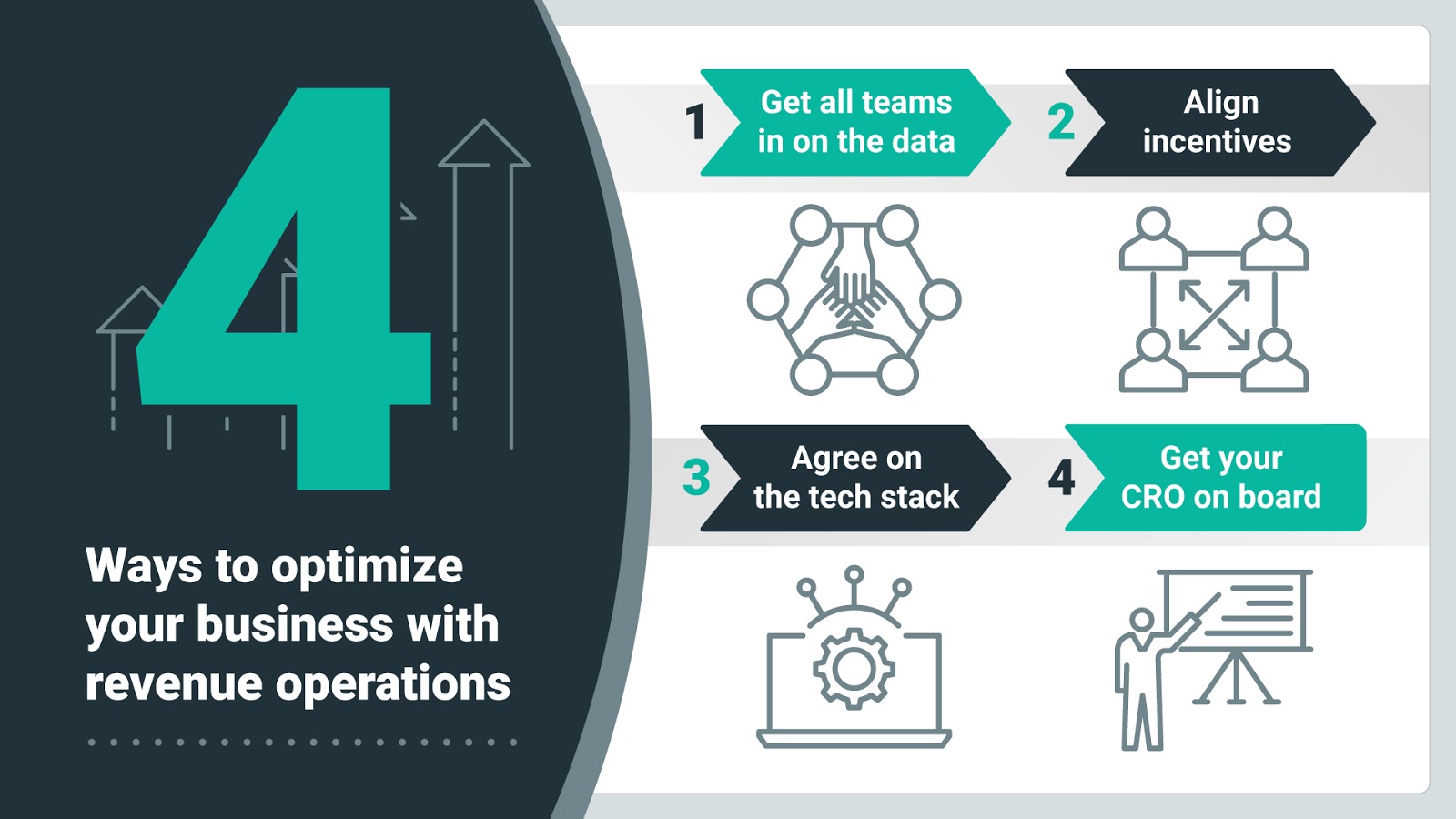
- Even before you create a RevOps policy, you need to hire a CRO. This new executive leader will move your initiatives forward.
- Next on the list is to perform a maturity assessment to develop an effective RevOps strategy. You need to create a roadmap taking into account the position of your business.
- Create a revenue growth strategy by documenting your team’s vision and goals. The CRO should discuss this with the CEO and other executives before developing a final plan.
- Change is complex for any organization. But at the same time, they are an absolute necessity. Implementing RevOps also requires organizational restructuring. When making changes, make sure your team can communicate effectively and your organization is transparent about their work responsibilities.
- Share your documented strategy with your go-to-market team. Help them understand how they can contribute through individual contribution and collaboration.
- Once RevOps teams have developed their initial strategy, they should focus on streamlining their tools.
- Helps with pipeline management, data visibility, and sales forecasting.
- This continuous workflow and process optimization step is critical when launching RevOps. CROs can seek feedback from customers and input from team members to learn how to automate processes and increase efficiency.
- After performing the above steps, you should continue to review your performance regularly. This provides clarity on how your team is adopting the RevOps model.
Best revenue management tool
RevOps tools are applications that allow you to share data and KPIs to keep marketing, sales, success, and other customer-centric teams aligned. These platforms help teams collaborate with greater responsibility. Here are the best RevOps tools to help you implement your model.
Clary
Companies looking to translate strategic goals into performance should choose Clari . This RevOps platform understands the value of revenue today and prevents revenue leakage.
Data from all your organization’s channels, from emails, meetings, and outbound marketing to conversations, is automatically accumulated. The platform uses real deal data to automatically generate predictions across all reps, overlays, channels, regions, and product lines.
Therefore, companies can make strategic decisions wisely and confidently and share them with shareholders and stakeholders. Clari also uses AI and ML algorithms to derive risk and actionable insights from a centralized database.
This platform can also be used for pipeline management. See existing and future trades and trades so you can stay on top of any changes, quickly identify risks and maximize opportunities.
Revenue.io
Revenue.io is an AI-powered RevOps application that helps your team grow faster. In addition to amplifying your top performers, you can find out what works best and optimize your revenue operations accordingly.
This platform gives you both the insights and tools you need to optimize real-time revenue performance. Revenue.io provides sales forecasting, performance insights, conversation intelligence, data and activity capture, buyer prioritization, conversation nudges, recommended coaching, and more.
Analyze conversation data with AI and develop the next best action for your team. This platform powers revenue operations and turns salespeople into superheroes.
gong
Gong is a revenue management software application that empowers your business with powerful data and incredible predictions. You can use it to capture activity data and generate predictions across your organization.
Use AI to analyze every customer interaction in your sales and CS departments and develop insights about your deals, teams, and pipeline. Gong gives you greater visibility into your trading capabilities, team performance, and market conditions.
Analyze conversations and make custom recommendations tailored to each team member. Therefore, members of the sales team know which topics need to be discussed more and which topics should be discussed less.
hubspot
To accommodate all RevOps features, HubSpot has released an updated suite called Operations Hub. HubSpot CRM provides all the tools you need for a complete end-to-end customer experience.
Hubspot also supports integration with many popular apps and platforms, so you can access your data from anywhere. Its key features include data synchronization, data quality automation, programmable automation, workflow extensions, team management and permissions, snowflake data sharing, datasets, and a custom report builder.
These tools allow you to connect apps, automate business processes, and categorize and store customer data from one central CRM platform. The result is an efficient, well-coordinated team that provides a frictionless experience for your customers.
FAQ
Companies can choose the RevOps model if any of the following occur:
1. Rapid team expansion
2. Earnings are stagnant for a while
3. Shift from a product-based growth strategy to a product-based sales strategy
4. Inability to manage data effectively
Yes, a Revenue Operations (RevOps) team structure is available. This involves team members who are supposed to bring revenue to one group. Rather than treating functions in isolation, RevOps teams combine data, resources, processes, and policies into a single team structure to achieve maximum benefit.
conclusion
In recent years, the way companies approach profitability has changed. That’s why we’re moving towards implementing a RevOps model to maximize your company’s revenue potential with full-funnel responsibility.
In this guide, we have touched on all the important aspects of RevOps, including its definition, benefits, pillars, metrics, and how to implement it. You can also learn about the best RevOps tools here.
You may also be interested in exploring new operational trends that are being adopted by many organizations.


![How to set up a Raspberry Pi web server in 2021 [Guide]](https://i0.wp.com/pcmanabu.com/wp-content/uploads/2019/10/web-server-02-309x198.png?w=1200&resize=1200,0&ssl=1)


